Enabling private financing for Positive Energy Neighbourhood
Incorporating social and environmental benefits into financial solutions
Credit: OpenLab project
Credit: OpenLab project
Resource
Context
Challenges of financing neighbourhood renovations
Positive Energy Neighbourhoods (PENs) are holistic urban interventions that integrate deep building renovations with infrastructure upgrades, and revitalising public space, greenery, water infrastructure and sustainable mobility.
The oPEN Lab project demonstrated replicable, commercially viable solution packages enabling to achieve PENs. Through three Living Labs, they identified some critical financing barriers to scaling up deep renovations. Even though PENs have one clear advantage over single-building renovations: aggregating smaller projects gives them scale, with typical investments of €10–70 million. However, investors still tend to see them as risky, because they involve complex ownership dynamics of private and public stakeholders with different bankability profiles. Private investors are also drawn to the profitable parts, such as solar panels, rather than the less attractive but essential work on building envelopes and systems.
But oPEN Lab identified financing solutions, considering the social and environmental co-benefits of PEN renovations. The project delivered key takeaways on how to deploy public funding most effectively to de-risk and unlock private investment, how to include vulnerable households in funding models, and how to leverage environmental, social and governance (ESG) finance.
The resource in a nutshell
Key takeaways and recommendations to finance PEN renovation projects
This policy brief draws on insights from stakeholder roundtables and provides recommendations for overcoming the high upfront costs and perceived risks of neighbourhood-scale renovations:
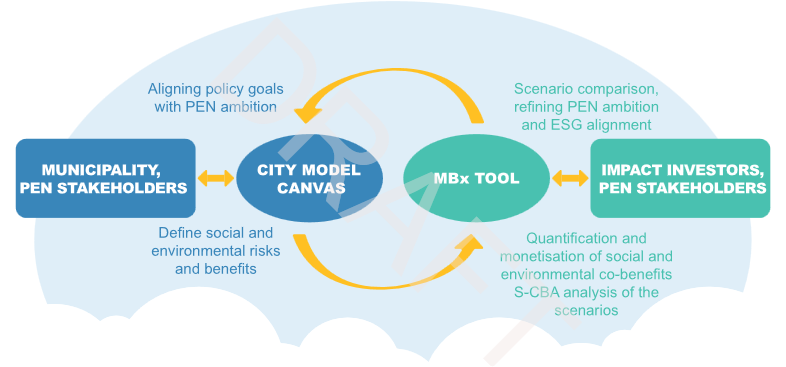
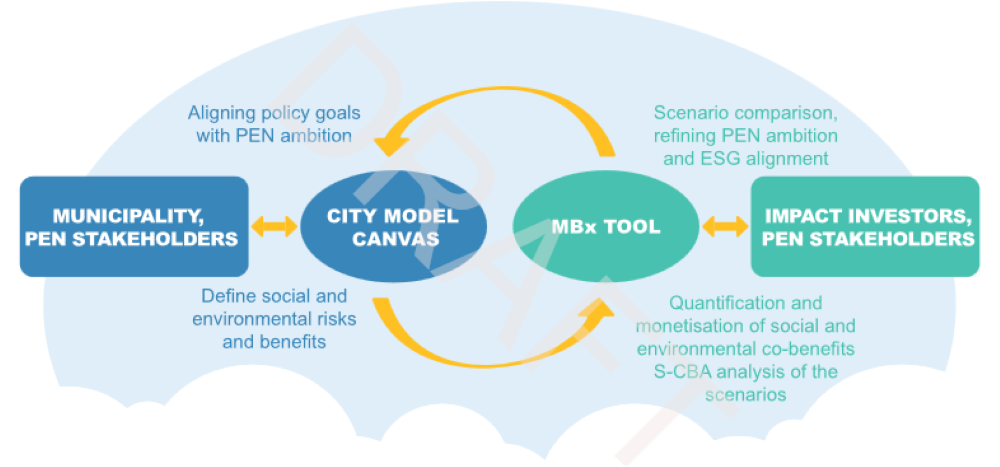
- Monetisation of co-benefits: the MBx tool, which allows users to monetise "non-energy" benefits such as health benefits (e.g. lower GP visit costs) resulting from living in healthy buildings and making use of sustainable mobility, such as cycling. Other relevant co-benefits for homeowners are asset value increase or vacancy cost reduction. By internalising these social and environmental gains, projects can demonstrate financial viability to ESG investors; for instance, the case study of GNICE case study in Salzburg showed a return on investment of 5.7% when health benefits were included.
- Stakeholder alignment: the City Model Canvas is a framework designed to capture the social and environmental co-benefits and drive ambition by aligning goals, investment costs and potential revenue streams of the various stakeholders. It ensures that investment costs and revenue streams (like flexibility services and reduced grid dependency) are clearly mapped across all beneficiaries.
- Blended finance and de-risking: blended financing solutions use public funds to provide guarantees that unlock larger sums of private capital. Special Purpose Vehicles and Renewable Energy Communities can be developed to aggregate assets and isolate project risks, making them more attractive to institutional investors like pension funds.
- Inclusive financing models: Models like the OPENGELA (a network of one-stop shops in the Basque country) offer for the lower-income group, a mix of grants and subsidies covers up to 80% of the renovation cost, the rest being a loan with public guarantees.
- Data-driven quality control: the use of Digital Twins and real-time monitoring is recommended to reduce technical risk by comparing predicted energy performance with actual results, thereby building investor confidence.
This project was funded by the European Union under the Horizon 2020 Framework Programme.